
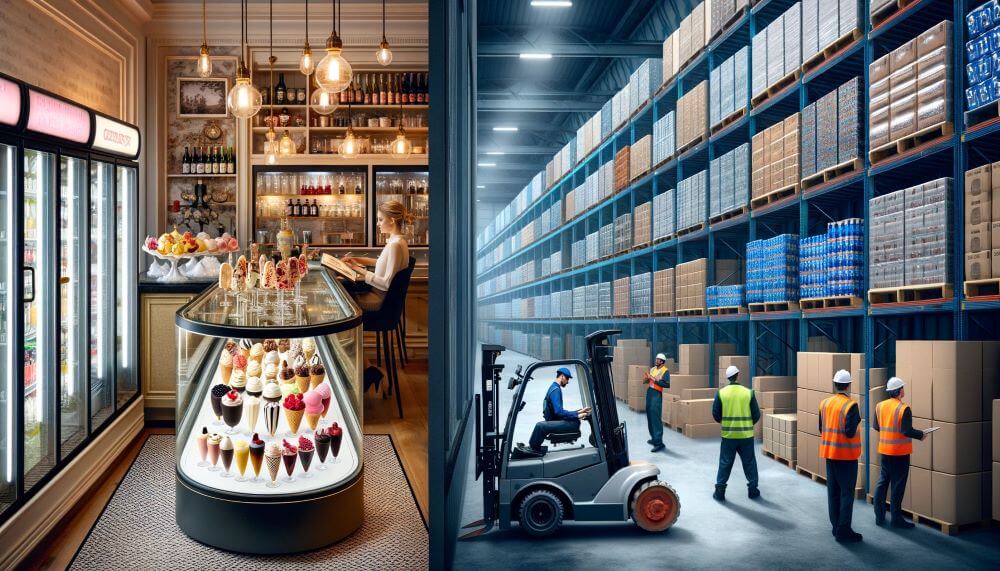
Refrigeration plays a critical role across multiple sectors, from food service and retail to manufacturing and pharmaceuticals. While the terms commercial refrigeration and industrial refrigeration are often used interchangeably, they refer to distinct systems designed for different scales, purposes, and operating environments. Even among the experts, such as Frontier Refrigeration commercial refrigeration companies, understanding this distinction is essential for selecting the right solution and ensuring efficient operations.
Defining Commercial Refrigeration
Commercial refrigeration criticizes the usage of refrigeration systems used by businesses that store, display, or process perishables at an intermediate rate and involves a reasonable level of refrigerated goods. This includes restaurants, supermarkets, hotels, cafes, hospitals, laboratories, and convenience stores.
Commercial refrigeration systems can include display refrigerators for storing food and drinks and displaying them to customers, walk-in freezers/coolers that provide cold storage for large amounts of food, beverage coolers that cool and hold beverages at the correct temperature, and refrigerated prep tables designed for quick and frequent access during food preparation. Additionally, the use of commercial refrigeration equipment includes ice machines. All of these refrigeration systems are specifically manufactured with a consistent (set) temperature for the purpose of meeting health/safety standards and have been designed with ease of maintenance and compact design to be energy efficient.
Defining Industrial Refrigeration
In contrast to commercial refrigeration, industrial refrigeration is typically used for large-scale industrial processes where heavy-duty cooling is required. Some examples of these types of applications include food processing plants, cold storage facilities, chemical production plants, milk production plants, brewing companies, and large-scale pharmaceutical facilities. Industrial refrigeration systems (which typically use NH3 and/or CO2 gas) have higher cooling capacities than commercial refrigeration systems, and they operate continuously and at a much higher capacity, often include more complex designs that utilize centralized systems and very large charge sizes. Industrial refrigeration systems typically utilize working fluids that have been identified as the most efficient and suited for use in large-scale cooling applications, and thus NH3, CO2, and others are common choices in industrial refrigeration systems.
Key Differences In Scale And Capacity
One of the most notable differences between commercial and industrial refrigeration lies in scale. Commercial refrigeration systems typically serve individual outlets or buildings, while industrial systems support entire production lines or storage facilities.
Commercial systems are usually modular and standardized, making them easier to install and replace. Industrial systems are highly customized, engineered to meet specific operational requirements, and often integrated into broader production processes.
Differences In System Design And Complexity
Commercial refrigeration systems are generally simpler in design, with self-contained or split systems that prioritize ease of use and accessibility. Maintenance tasks are relatively straightforward and can often be handled without shutting down entire operations.
In contrast, industrial refrigeration systems are more complex, requiring specialized engineering, advanced safety controls, and trained personnel for operation and maintenance. Any downtime in an industrial setting can have significant operational and financial implications.
Regulatory And Safety Considerations
The government regulates both commercial and industrial refrigeration systems, but the level of regulation for each type of system may vary widely. Commercial Refrigeration Systems have many more regulations surrounding food safety, hygienic conditions of the unit, and energy efficiency of the unit because the systems are located on the public side of a business. Industrial Refrigeration Systems must comply with more stringent safety requirements than commercial systems because industrial refrigeration systems operate with higher-pressure systems and include refrigerants that could be potentially hazardous. Industrial refrigeration management involves ensuring compliance with occupational safety, environmental, and emission regulations.
Energy Use And Operational Focus
Energy Use and Operational Focus Commercial Refrigeration focuses on consistent performance, energy efficiency, and user-friendliness of the systems; therefore, many commercial refrigeration units are optimised to provide the lowest operating cost while still delivering reliable performance. Industrial Refrigeration focuses on extreme efficiency at scale and sustaining the systems over a longer timeframe. In industrial refrigeration, energy optimization techniques can include heat recovery, automation technology, and centralised monitoring of refrigerative units to decrease total energy consumption.
Choosing The Right Refrigeration Approach
Selecting between commercial and industrial refrigeration depends on factors such as application size, cooling requirements, regulatory obligations, and long-term operational goals. Businesses benefit from clearly understanding their needs before engaging with service providers or manufacturers.
By recognizing the fundamental differences between these two refrigeration categories, stakeholders—including those evaluating options across the market and among entities like Frontier Refrigeration commercial refrigeration companies—can make more informed decisions that align with their operational and compliance requirements.