
Most tire guides tell you to check your tread every month. I’d bet money you’ve never done it. And if you drive in Visalia or anywhere between Fresno and Bakersfield, that monthly rule undersells the problem, because your tires are cooking on pavement that spends half the year well above 90 degrees.
Here’s the short answer: tread depth tells you when a tire is legally done, age tells you when it’s structurally done, and Central Valley heat shortens both timelines. A tire that would last five years in Portland might be sketchy at three here. You can’t fix it with a pressure gauge alone. You have to read the rubber.
You’ve got two paths. You can chase the cheapest set from whoever answers the phone, or you can work with a shop that matches load rating and tread compound to the way you actually drive. For most Honda owners around here, that means Honda tire service Visalia CA, where the techs know which all-seasons survive a summer on Ben Maddox Way and which ones cup after 20,000 miles.
Why heat changes the tire math
Rubber is a polymer, and polymers age faster when they run hot. Every time you park on asphalt in July, the tire soaks up heat and the compounds slowly lose elasticity. That’s the real reason a six-year-old tire with 5/32 inch of tread can still crack at the sidewall. The tread isn’t the only thing you’re inspecting.
According to the National Weather Service, the San Joaquin Valley regularly sees triple-digit highs in summer, and surface temps on dark pavement run considerably hotter than the air. That’s a lot of cumulative exposure for a tire that never gets a break. If your car sits outside all day, count on replacing sooner than the owner’s manual suggests.
The four-lane test I actually use
I call it the four-lane test because it’s four checks, in order, and you do it standing next to the car in about five minutes. No lift, no appointment. If you get through all four and everything passes, you’re fine for another few months.
- Lane 1, the penny and the quarter. Stick a penny in the groove upside down. If Lincoln’s whole head shows, you’re at 2/32 inch and legally worn out. A quarter gets you to 4/32, which is where wet grip starts falling off a cliff.
- Lane 2, the sidewall date code. Four digits inside an oval, like 3221. That means the 32nd week of 2021. Over six years old, replace it regardless of tread.
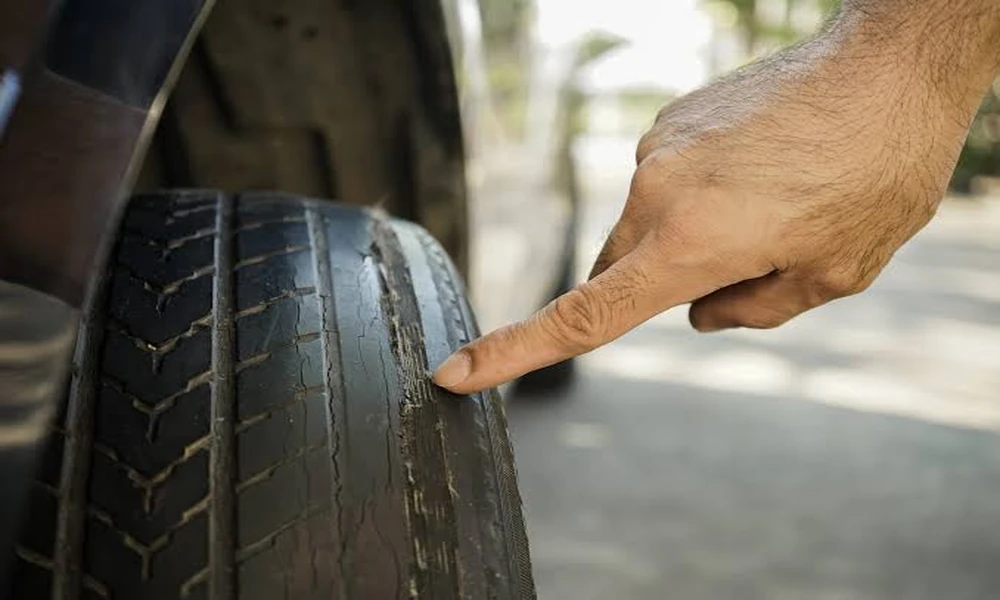
- Lane 3, uneven wear. Run your hand across the tread. If the inside edge is noticeably lower than the outside, you have an alignment problem, and new tires will just wear the same way.
- Lane 4, cracks and bulges. Fine hairlines in the sidewall grooves are cosmetic early on. A bulge is not. A bulge means internal belt damage and that tire comes off the car today.
Lane 3 is the one people skip, and it’s the most expensive to ignore. Worn inner edges mean you’ll buy tires twice.
What the manuals and the feds agree on
At 2/32 inch of remaining tread, a tire is legally worn out in most states, and the National Highway Traffic Safety Administration uses that threshold to define when a tire should be pulled from service. That’s the floor, not the target. I’d argue you should replace at 4/32 if you drive Highway 99 in winter rain, because hydroplaning risk climbs steeply below that.
A local scenario worth borrowing
A reader emailed me last spring about her Civic. She’d bought tires in 2022, drove about 14,000 miles a year, mostly Visalia to Fresno, and the tires looked fine at the outer edge. She’d had one flat repaired twice. Her complaint was a vibration at 65 mph.
What we found after a proper inspection: cupping on both front tires, an alignment that was nearly two degrees out, and a rear tire with a sidewall date code four years old and a slow leak at the bead. The tread wasn’t the problem. The geometry was.
That’s the pattern I see again and again out here. Dust and road grit get into the bead, small alignment drift goes unaddressed, and by the time the tread is gone, so is the tire’s internal structure. The fix isn’t just a new set. It’s a new set plus an alignment plus a rotation schedule you actually follow.
How long should a set really last out here?
Roughly 40,000 to 60,000 miles for a quality all-season on a sedan, a bit less for an SUV or a truck doing farm or ranch work, and a bit more if you mostly do short, low-speed city trips. Those are baselines, not promises. The variance comes from alignment, inflation habits, and how much sun your car sees.
One thing I’d push back on: don’t chase the cheapest set at the discount warehouse. Heat is unforgiving, and cheap compounds age faster. You’ll pay the difference at the second replacement, not the first.
Reading tires and load ratings
If you want to understand what the numbers on the sidewall mean before you shop, the U.S. Department of Transportation publishes the baseline standards that govern tire labeling, including the load index and speed rating. An Accord with a 91 load index and a Ridgeline with a 111 are not interchangeable, and a shop that doesn’t ask you about payload isn’t paying attention.
The rotation schedule that actually works
Most manufacturers recommend rotating every 5,000 to 7,500 miles. I’d set a phone reminder at 6,000 and pair it with your oil change. Every other oil change is a rotation, in other words. That’s the whole system, and it costs you nothing.
Check pressure when the tires are cold, meaning first thing in the morning before you drive. The number on the door jamb is the one that matters, not the max pressure printed on the sidewall. That’s the single most misread number in car ownership, and I’d bet it’s wrong on at least one tire in your driveway right now.
When to keep them, when to pull the trigger
You’re fine to keep driving if your tread passes the quarter test, your sidewall code says under five years, and the wear is even. You’re overdue if any of those three fails, if you’ve had two or more repairs on the same tire, or if you can’t remember the last time you checked pressure. That last one is the most common answer I get.
And if you’re not sure how to read the date code or the wear pattern, that’s a two-minute conversation with a tech, not a research project. Bring the car in, get a free tread measurement, and walk out with an honest answer instead of a sales pitch.
Your tires are the only thing between you and the road, and in this valley they take more abuse than most American drivers can imagine. So here’s the question worth asking yourself right now: when did you last actually look at them?